
-
 Shopping Cart (0)
Cart Total:
Your cart is currently empty..
Vape Hardware Engineering
Empty Disposable Vape Hardware Components Explained: Complete Manufacturing Guide
- Monday, 14 September 2026
- 0
- 185
- 0
Key Takeaways
✓ Empty vape hardware includes the device structure without oil, branding or final packaging.
✓ Battery, coil, tank and airflow systems must be matched during hardware selection.
✓ Component compatibility directly affects leakage control and vapor consistency.
✓ OEM buyers should evaluate specifications, samples and QC procedures before mass production.
✓ Customization options include housing colors, logo printing and packaging solutions.
What Is Empty Disposable Vape Hardware
Empty disposable vape hardware is a business-to-business product. Suppliers sell it to qualified brands or processors. It is not a device ready for consumers. The buyer gets parts only. There is no oil, no e-liquid, and nothing usable until filling. An empty disposable vape is a single-use electronic cigarette device made without any e-liquid, oil, or concentrate. It has essential components—a battery, a heating element, and a reservoir—but the brand does the final filling step. This difference separates hardware engineering from the claims of the finished product.
Hardware-Only vs. Pre-Filled
Hardware-only devices arrive with no liquid at all. The buyer does the filling, labeling, and final assembly. Pre-filled devices come ready to sell in stores. The manufacturer fills and seals them before shipping. Hardware-only products give brands more control over the final product. They also cut down shipping weight and legal complexity. Pre-filled units make buying easier for consumers. However, they lock brands into specific formulations and packaging. The choice depends on the brand's business model and target market.
The Role of "Empty" in Branding
The word "empty" signals flexibility. Brands can put on their own logo, colors, and design. They pick the flavor, nicotine strength, and packaging. This freedom builds brand identity. It also allows quick responses to market trends. A brand can test multiple flavors with the same hardware. The empty format supports private labeling and custom retail presentation.
Who Buys Empty Hardware
Empty hardware serves several types of buyers. Each one has different needs and production goals. Understanding these buyers helps suppliers adjust their services.
Brand Owners and Startups
Brand owners want control over their final product. They want unique flavors and packaging. Startups enter the market with limited money. Empty hardware lowers their upfront investment. They can buy generic devices in bulk. Then they fill and brand them locally. This approach lowers risk and speeds up market entry.
Distributors and OEM Partners
Distributors buy empty hardware to resell. They supply brands and filling operations. OEM partners provide manufacturing services. They fill, package, and label devices for brands. These partners need reliable hardware sources. Consistent quality and fast delivery matter most to them.
Benefits for Manufacturers
Empty hardware offers clear advantages for production planning. Brands gain flexibility and cost savings. They also reach the market faster.
Cost Control and Flexibility
Brands can buy large amounts of generic, unbranded hardware. This approach lowers capital risk. It also protects against customs delays and supply chain ups and downs. Separating hardware from final branding means unsold inventory does not become scrap. Product identifiers can be updated in the warehouse easily. This flexibility improves safety stock levels.
Faster Time to Market
Sourcing bulk empty devices and filling them closer to the target market speeds up launch. Brands separate hardware purchasing from final filling and labeling. They can launch or discontinue flavors without waiting for finished-goods production. Local labeling flexibility allows adjustments by market. This model shortens actual launch time significantly.
Key Empty Disposable Vape Components
Device capacity, airflow design, battery size, and core type all change how the vape performs. The hardware must fit the oil thickness and fill needs. Each part below has a job in the final product.
Core Components of Empty Vape Hardware
1. Battery System
2. Reservoir / Tank
3. Heating Element
4. Airflow Structure
5. PCB Control System
6. Housing and Mouthpiece
Battery and Power System
The battery gives power to the heating part. It sets how many puffs, vapor amount, and how long the device lasts. Makers balance power with size and weight.
Battery Types and Capacities
Non-rechargeable disposable vapes usually have batteries from 280mAh to 1,000mAh. Rechargeable ones often use 500mAh to 650mAh cells. Medium-capacity batteries (200–500 mAh) dominate the market in 2025. They balance battery life and small size. Low-voltage systems (3.0V–3.5V) are most common because they give steady, smooth vapor without heating e-liquid too much. Medium-voltage systems (3.6V–4.0V) are growing fastest because people want stronger taste.
| Battery | Application |
|---|---|
| 230-280mAh | Compact AIO |
| 300-400mAh | Standard 2ML hardware |
| 450-650mAh | Large capacity / rechargeable |
High-density small batteries now give more puffs in the same small space. Safety design now sets products apart. Overcharge protection, short-circuit protection, and heat-resistant materials meet rules in the U.S. and EU. Smart puff control uses chips to keep voltage steady and control discharge for even flavor. AI makes batteries more efficient by looking at how people use them, temperature changes, and voltage. AI sensors find overheating and battery problems before they cause accidents.
Rechargeable vs. Non-Rechargeable
Non-rechargeable models are simple and cost less. Users throw away the device when the battery dies. Rechargeable models have a charging port and control circuits. They stop overcharging and overheating when plugged in. Regular wall adapters or computer ports work best. Fast chargers can damage batteries unless the maker says they are okay.
Essential Safety Tips for Disposable Vape Batteries:
- Avoid extreme heat: never leave a device in a hot car or in the sun.
- Physical damage: stop using right away if the shell is cracked, crushed, or dented.
- Use proper chargers: avoid fast chargers unless the maker says it’s okay.
- Water exposure: devices are not waterproof; sinking them can short-circuit the inside.
Tank and E-Liquid Reservoir
The tank holds the e-liquid before it turns to vapor. The materials and sealing affect leak resistance and how long it lasts. A good tank keeps the wick wet without flooding the coil.
Tank Materials and Sealing
Makers use food-safe plastics and silicone seals. These materials do not react with e-liquid chemicals. Good sealing stops leaks during shipping and storage. A leak-proof battery case also keeps away chemicals. The seal between the tank and coil is most important. A bad seal causes dry hits or flooding.
Common Fill Volumes
Fill amounts vary by device size and target market. Small devices hold less liquid for short use. Larger ones hold more for longer use. The fill amount must match the battery size. A big tank with a small battery wastes puffs. Buyers should check that the fill amount meets their puff goals.
Mouthpiece, Heating Element, and Shell
These three parts shape how the device feels. The mouthpiece affects comfort. The coil and wick decide vapor quality. The shell protects inside parts and holds branding.
Mouthpiece Design and Material
Mouthpiece materials must handle chemicals from vapor and saliva. Medical-grade silicone resists chemicals well and stands up to disinfectants and moisture. Soft plastic is a basic choice with less lip pressure. Oval shapes with curves reduce pressure points better than flat ones. Material density affects comfort over long use.
Coil and Wick Specifications
Standard disposable coils are 1.2Ω to 1.8Ω for tight draws. Sub-ohm mesh coils (0.6Ω–1.0Ω) make more heat and vapor. Organic cotton and silica are common wick materials. They soak up liquid well and handle heat. Many disposables use polyfill around the coil as both wick and tank. Newer high-capacity models use a liquid-only tank that feeds a smaller cotton wick. This design keeps flavor clear for many puffs.
Shell Construction and Finish
The shell protects the battery, tank, and coil. It also gives a surface for branding. Makers use strong plastics and metals. Finishes can be matte or glossy. The shell must handle drops and daily use. Custom colors and logo printing happen here. A good shell makes it easier to hold and feel better.
Component Specifications at a Glance
Buyers need clear numbers before they place a hardware order. The tables below show the most common specs for empty disposable vape hardware. These numbers help purchasing teams compare choices. They also help match parts to fill volumes and target puff counts.
Battery Specification Table
The battery decides the device's puff count and overall size. Standard disposable vapes usually have 280–650 mAh cells. They put out about 3.7 V. Small, slim low-puff devices sit at the low end of that range. High-puff rechargeable devices use 500–650 mAh cells. As e-liquid capacities grew from 2 ml to 15 ml or more, bigger batteries like 2,000 mAh became too bulky. So brands switched to smaller rechargeable lithium-ion batteries. These are usually rated between 500 mAh and 650 mAh and pair with USB-C charging. They give about 400 to 600 puffs per charge. The device still works for thousands of puffs until the e-liquid runs out.
| Device Category | Battery Capacity (mAh) | Voltage Output |
|---|---|---|
| Standard disposable vapes | 280–650 | ~3.7 V (regulated) |
| Small/slim low-puff devices | Lower end of 280–650 | ~3.7 V (regulated) |
| High-puff rechargeable devices | 500–650 | ~3.7 V (regulated) |
Capacity: Typically 360 mAh to 500 mAh, designed to last until the e-liquid runs out.
Tank and Coil Table
Tank volume and coil resistance must work together. A large tank with a high-resistance coil drains slowly and may flood. A small tank with a low-resistance mesh coil drains fast and risks dry hits. Buyers should match fill volume to the intended puff count and battery capacity. The table below lists common pairings.
| Tank Volume | Coil Resistance | Wick Material | Typical Use |
|---|---|---|---|
| Small (under 2 ml) | 1.2Ω–1.8Ω | Organic cotton | Low-puff, slim devices |
| Medium (2–5 ml) | 1.0Ω–1.5Ω | Cotton or silica | Standard disposables |
| Large (5 ml+) | 0.6Ω–1.0Ω mesh | Cotton with polyfill | High-puff rechargeable |
Shell and Mouthpiece Table
Shell material and mouthpiece design affect durability and user comfort. Strong plastics and metals protect the inside parts. Medical-grade silicone mouthpieces resist chemicals and moisture well. The table below compares common options.
| Shell Material | Finish Options | Mouthpiece Material | Best For |
|---|---|---|---|
| ABS plastic | Matte, glossy | Medical-grade silicone | Cost-sensitive lines |
| PC plastic | Glossy, soft-touch | Soft plastic | Mid-range devices |
| Aluminum alloy | Anodized, brushed | Silicone or TPE | Premium branding |
Buyers should confirm these specs with their supplier before ordering. Small changes in battery capacity, coil resistance, or shell material change how the whole device performs. A clear spec sheet prevents costly mismatches during production.
Evaluating Hardware for Your Line
Picking the right hardware decides if your product line does well. Buyers must compare specs, test samples, and plan custom features. This part explains how to check empty disposable vape hardware before you place a big order.
Product Selection Criteria
Good buyers start with two questions. How long does the device last? How does it feel to use? These things make people buy again and stay loyal.
Puff Count and Battery Life
Puff count numbers like 35K, 50K, and 100K come from lab tests. Labs use 1–2 second puffs that don't match how people really vape. Battery life is a better sign of whether users are happy. A device with a 1,200 mAh battery truly holds more power than one with 650 mAh. This difference shows up in three ways. First, bigger batteries keep vapor production and flavor stronger for longer. Second, they need fewer recharges, which means less waiting for heavy vapers. Third, they help users use all the e-liquid. A device that dies with e-liquid still inside wastes money.
| Battery Tier | Capacity Range | Days Between Charges (Moderate Use) | Output Consistency |
|---|---|---|---|
| Standard | Below 700 mAh | 1–2 days | Output drops a lot as battery runs low |
| Mid-range | 700–900 mAh | 2–3 days | Steady output all the way |
| High performance | 1,000–1,200 mAh | 3–4 days | Consistent output |
| Flagship | 1,500 mAh+ | Many days at full output | Battery never holds you back |
Draw Activation and Airflow
Airflow design controls how the device feels when you use it. Fixed airflow designs are set by the maker. Small differences between units can happen because of how they're made. This can cause uneven draw resistance. Draw resistance is how much work you need to pull air in. A tighter draw feels like a cigarette, which helps smokers switch. A looser draw lets you inhale easily. Airflow also changes vapor amount. More open airflow gives more vapor but can weaken flavor. Restricted airflow boosts flavor but may make the draw warmer and harsher. Dust, dirt, and leftover e-liquid can block the air intake. Blockages lower airflow and lead to weak pulls. A multi-step airflow test during quality checks makes sure every unit pulls smoothly.
Customization with bestvapesupply
Customization turns plain hardware into a brand product. bestvapesupply offers OEM services that include logo printing, color choices, and shell finishes.
Logo, Color, and Shell Branding
Brands can ask for custom hardware colors, metal and soft-touch finishes, device wraps, and laser engraving. Logo printing goes directly on cartridges, all-in-one devices, and batteries. Finish options include matte, gloss, metallic, soft-touch, gradient, and special coatings. Mouthpieces come in many shapes, materials, and premium zirconia options. Rubber coating is available in any color. Colorful LED lights and stylish mouthpieces add visual appeal. Compliance label engraving and printing help meet rules. Custom packaging solutions finish the retail experience.
Flavor and Nicotine Compatibility
Hardware must match the e-liquid formula. Coil resistance and wick material affect how well a device handles different thicknesses. A device built for thin e-liquid may leak with thick oil. A device built for thick oil may give dry hits with thin e-liquid. Buyers should check compatibility before ordering. bestvapesupply helps match hardware to specific flavor and nicotine profiles.
Sample Policies and Testing
Samples let buyers check quality before large production. A structured sample process lowers risk and stops costly mistakes.
Sample Request Process
Buyers should ask for samples that match their needed specs. A good supplier offers a structured pre-production sample (PPS) and golden sample sign-off process. This step confirms the hardware meets expectations. Buyers should test draw resistance, vapor output, and battery performance. They should also check for leaks and how strong the device is.
Pre-Production Testing Checklist
Top manufacturers run several tests before production. Resistance consistency checks that coil resistance stays within a tight range (about ±0.05Ω) across a batch. Heating uniformity uses thermal cameras to confirm even heat spread. Hot spots cause burnt or dry hits. Oil utilization rate measures leftover oil after a cartridge runs empty. Above 3–5% leftover means wicking is not efficient. Puff count testing checks that vapor output stays steady through all the oil. Clog rate testing measures how often clogs happen for thick distillate and live resin. Structural strength tests include drop tests and torque tests on the mouthpiece and base. Assembly tolerance control checks supplier specs (usually ±0.02–0.05mm on key parts) with CMM inspection. All prototype hardware goes through heat, vacuum, shake, and storage tests that copy real shipping and shelf life.
Using an empty cartridge without oil can damage the heating part. This may cause dry hits, burnt flavors, and possibly harmful chemicals.
Buyers should also check supplier credentials. Ask for business licenses, tax IDs, and factory info. Look for ISO 9001, CE, RoHS, FCC, TPD, and FDA PMTA if those are needed in your market. Read buyer feedback, audit history, and how fast they respond. Confirm minimum order amounts for stock, custom branding, and hardware changes.
Manufacturing Integration and QC

MOQ, Lead Times, and Planning
Typical MOQ Ranges
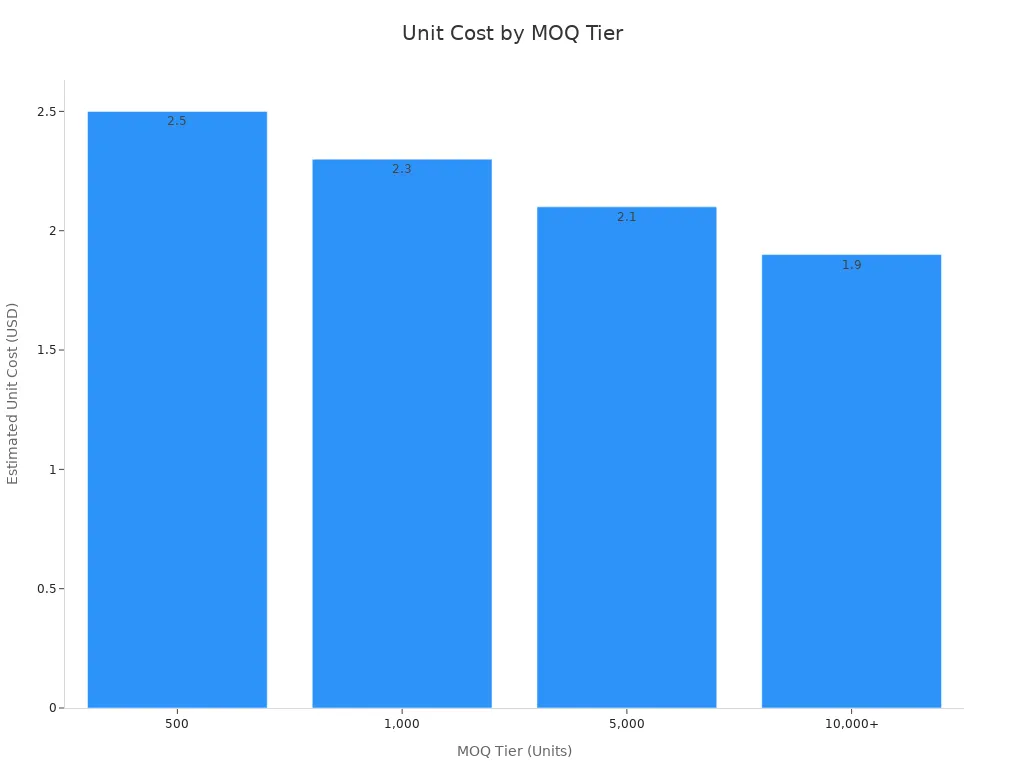
Minimum order quantities change based on the supplier and how much you customize. Some buyers can find suppliers with MOQs as low as 500 units. Others need 5,000 units or more. Most suppliers want at least 1,000 pieces for custom packaging. This amount is normal for cartridges, batteries, and disposables.
| Supplier | MOQ (units) |
|---|---|
| Yumyth Electronic Tech Co., Limited | 5,000 |
| Dongguan Fog Legend Electronic Technology Co., Ltd. | 1,000 |
| HK TABACO TRADE LIMITED | 500 |
The price per unit goes down when you order more. A 500-unit order might cost $2.50 per unit. At 10,000+ units, the price can drop to $1.90 per unit.
Production and Shipping Timelines
How long production takes depends on your order size and customization. Stock hardware ships faster than units with your brand on them. Custom logo printing and shell finishes add more time. Buyers should plan ahead for sample approval, production, and shipping. Overseas warehouses help shorten delivery time for repeat orders.
Quality Control and Compliance
Incoming Component Inspection
Every batch of Empty Disposable Vape hardware needs a check before assembly. Buyers should test battery voltage, coil resistance, and tank seals. A clear checklist stops bad parts from getting onto the production line.
Leak, Draw, and Battery Safety
Leak testing makes sure tank seals hold up during shipping and storage. Draw testing checks airflow resistance across all units. Battery safety tests cover overcharge protection and short-circuit prevention. Suppliers should give CE, RoHS, FCC, and UN38.3 battery transport certifications for international shipping.
| Standard | Description |
|---|---|
| CE Certification | Confirms compliance with European safety, health, and environmental protection requirements |
| RoHS Compliance | Restricts hazardous substances to ensure safer, eco-friendly materials |
| FCC Verification | Verifies electronic devices meet U.S. regulatory requirements |
| SGS Testing Reports | Independent third-party quality and safety verification |
Filling, Packaging, and Branding
E-Liquid Filling Methods
The best filling method depends on your batch size and how thick the e-liquid is. Peristaltic pumps work well for many flavors and short batches. Servo piston pumps handle high-VG or thicker e-liquid with steady product movement. A modular 2–8-nozzle line with saved recipes gives flexibility for growing contract packers.
| Filling Technology | Best Application | Main Advantages |
|---|---|---|
| Peristaltic pump | Low-to-medium viscosity and frequent flavor changes | Limited product contact and convenient tube replacement |
| Servo piston pump | Medium-to-high viscosity and high-VG formulas | Strong product movement and adjustable filling volume |
| Ceramic pump | Precise small-dose filling | Wear resistance and controlled metering |
| Timed-flow pump | Free-flowing and consistent formulations | Straightforward operation and scalable nozzle count |
Retail Packaging and Labeling
Packaging has to follow local rules. Labels need nicotine warnings, ingredient lists, and batch codes. Custom boxes and display trays help build brand identity at retail. bestvapesupply offers OEM services, overseas warehouses, and fast shipment for empty 510 cartridges and empty disposable AIO hardware. Buyers can send an RFQ to confirm specs, MOQs, and timelines.
Learning about each part of Friendly Farm empty disposable vape hardware helps manufacturers make better products. Batteries, tanks, coils, and shells all affect how the device works and looks. Empty hardware lets brands change things, control their own branding, and make more devices easily. bestvapesupply helps buyers with custom services, overseas storage, and quick shipping. Buyers should ask for samples, check details, and plan custom features and quality checks early. A good product line begins with smart hardware choices. Careful review now gives you an advantage later.
FAQ
What components should buyers check before ordering empty vape hardware?
Buyers should review battery specifications, heating system, tank structure, airflow design, materials and QC procedures.
What battery capacity do standard disposable vapes use?
Standard disposable vapes usually use batteries between 280 mAh and 650 mAh. Small, slim devices with few puffs use the lower end. High-puff rechargeable models use 500 mAh to 650 mAh cells.
Can empty vape hardware be customized?
Yes. OEM customization may include colors, logo printing, housing design, packaging and hardware specifications.
How does coil resistance affect vapor production?
Coil resistance controls how tight the draw feels and how much vapor you get. Standard coils (1.2Ω to 1.8Ω) give tighter draws, like a cigarette. Sub-ohm mesh coils (0.6Ω to 1.0Ω) make more heat and bigger vapor clouds.
What materials are tanks made from?
Tanks use food-safe plastics and silicone seals. These materials do not react with e-liquid chemicals. Good sealing stops leaks during shipping and storage. The seal between the tank and coil matters most for performance.
How can buyers test hardware before ordering?
Buyers should ask for samples that match their specifications. They test draw resistance, vapor output, battery performance, leaks, and how strong the device is. A clear pre-production sample process lowers risk and stops costly mistakes.
What certifications should empty hardware have for international shipping?
Manufacturers should provide CE, RoHS, FCC, and UN38.3 battery transport certifications. These show compliance with safety, environmental, and shipping rules in major markets like the U.S. and EU.
How does bestvapesupply help with customization?
bestvapesupply offers OEM services like logo printing, custom colors, shell finishes, and packaging. They provide overseas warehouses and fast shipment. Buyers send an RFQ to confirm specs, MOQs, and timelines.
About This Article
Written by:
Best Vape Supply Hardware Engineering Team
Reviewed by:
Battery & Hardware Development Team
Expertise:
• Empty Vape Hardware
• Battery Systems
• Coil Engineering
• OEM Manufacturing
0users like this.
-
Posted on Thursday, 10 September 2026
0comments
- Empty Vape Hardware
- OEM vape hardware
- Dual Chamber Vape Hardware
- Thick Oil Vape Hardware
- dual chamber vape hardware
- Disposable Vapes
- Packman 4G
- ACE Ultra
- ACE Ultra Vape Pen
- Empty Disposable Hardware
- postless vape hardware
- OEM Manufacturing
- Rechargeable vape hardware
- Dual Chamber Hardware
- 10/10 Boys Switch
- Fryd dual chamber vape
- Fryd vape pen
- Fryd 2g
- Fryd disposable 2ml
- DRANKS DUAL Disposable Vape
- dual flavors
- Vape Battery
- HITZ ZEUS EDITION 2G
- HITZ Infinity Blue 2ML Pens
- HITZ Infinity
- HITZ ZEUS
- Dual Chamber Vape
- 2g Disposable
- Dual Tanks vape pen
- Disposable Vape Pens
- Wholemelt Phase Five Switch Vapes
- Wholemelt Switch Vapes 2G
- Wholemelt Vapes 2G
- DUAL Disposable Vape
- 2ML Dual Tanks
- 2G Disposable Vape
- MUHA MEDS Gen
- Splitz Vape Pen
- Splitz Vapes 2G
- Muha meds 2G
- Splitz 2ml
- TURNONE 2ML Empty Vape Hardware
- TURNONE 2ML
- customization
- 2ML Empty Vape
- ACE 2ml Vapes
- Packman 2ml vapes
- Whole Melt Candy Shop Switch 2G
- Whole Melt Candy Shop Switch
- dual-chamber
- OG Cake
- Cake 2ml vapes
- OG Cake Vape Pen
- Cake 2G Vapes
- MUHA MEDS Gen 3
- Muha meds 2ml
- Muha meds Switch
- Muha Meds 2.5G
- Sherbinskis Quattro 2G
- activation failure
- FAVORITES Disposable 3G
- Disposable 3G
- FAVORITES Disposable
- FRYD SWITCH DISPOSABLE 2G
- FRYD Switch 2G
- disposable vape
- FRYD 2g
- Dual Chamber Pens
- HITZ ZEUS Edition 2G
- MUHA MEDS Melted Diamonds vape
- HITZ ZEUS 2G
- MUHA MEDS Melted Diamonds 3.5G
- Push V2 Summer Vape Pen
- Push V2 Summer Vape Switch
- Push 2G Vape Switch
- Push 2G Switch
- Boutiq Switch ORB V5 Triple Tank
- Boutiq Switch ORB V5
- Boutiq Switch
- Triple Tank Vape
- Packman Partyboyz Disposable Vape
- Packman Partyboyz 3G
- Packman vape pen
- Packman 2g vapes
- Raw Garden Adjustable Voltage
- Raw Garden 2G
- Raw garden Vapes
- Raw garden vape pen
- MUHA MEDS Empty Vape Pen
- SHERBINSKIS QUATTRO 2G
- MUHA MEDS 2g Vape Pen
- dual chamber Vape Pen
- Muha Meds empty vape
- 3.5ML Muha Meds
- Muha Meds 2ml
- Crybaby Trios 3G
- Crybaby Trios 3G Empty Disposable Vape
- disposable vape hardware
- Muha Meds Gen 3 empty hardware
- HitZ Infinity 2G empty hardware
- Slugger Hit 3G Triple-Chamber Vape
- Multi-Flavor Hardware
- disposable empty hardware
- Airflow Blockage
- Thick Oil Empty Vape Hardware
- thick oil vape cartridge
- OEM empty vape hardware
- DONUTS Switch GEN 2 E
- 2ML Dual Chamber Vape
- DONUTS Switch Pen 2ML
- Boutiq Switch V5
- Boutiq Dual Chamber
- Empty Vape Hardware Quality Control
- LUIGI V9 2G Empty Vape Hardware
- Donuts Gen 2 Dual Chamber
- Sprinklez Disposable Vape
- Sprinklez Disposable 2G
- Muha meds glass jars
- ACE Glass jars
- custom packaging
- UNIPUFF SWITCH DISPOSABLE 2G
- Muha Meds GTA edition
- Alien Labs Dual Empty Disposable 2G
- Alien Labs Dual
- vape pen overheating
- vape hardware troubleshooting
- vape battery overheating
- Raw Garden Vape Pen
- Ceramic Coil
- rechargeable disposable
- 2ML Empty Vape Hardware
- OG Cake Legendary Edition
- CRYBABY TRIOS 3 IN 1
- Multi-Chamber Vape
- manufacturing process
- BIG CHIEF DUO V3 Empty Vape Hardware
- Single Chamber Vape Hardware
- Sluggers Hit dual chamber
- OEM vape manufacturer
- 510 Thread Vape Cartridge
- Dual chamber
- LED screen devices
- All-In-One Vape Hardware
- Dual Vape Hardware
- 510 cartridge hardware
- ceramic vape cartridge
- OEM cartridge supplier
- ACE Ultra 2ml Dual Chamber
- Donuts Switch V4 Dual Chamber
- Single-Chamber Disposables
- Ceramic Coil Guide
- Thick Oil Hardware
- CALI CLEAR 2G
- Oil flow problems
- Ace Ultra Switch
- Ace Ultra Premium Empty Vape Hardware
- LED screen vape hardware
- Smart vape hardware
- Voltage Control
- Buzz Bar 3G Switch
- 10/10 Boys Single Flavor
- multi chamber vape hardware
- Sluggers Dual Chamber
- SMOOTHIE BAR BLEND 3.0 Switch
- Switch Empty Vape Hardware
- Multi-Chamber Empty Vape Hardware
- vape hardware airflow
- multi-chamber hardware leakage
- BESOS 3 Flavors Switch
- BESOS 3 Flavors Switch Empty Vape Hardware
- Slugger Hit 3 tanks SWITCH 3G
- 10/10 Boys Switch clogging
- SHERBINSKIS QUATTRO 2G dual chamber vape hardware
- Packman x Jeeter DUAL CHAMBER Vape Hardware
- 2G disposable vape
- Empty Triple-Chamber Vape Hardware
- OEM triple chamber vape hardware
- postless dual-chamber vape hardware
- ceramic vape hardware
- triple chamber vape hardware
- 1mL + 1mL dual-chamber vape
- dual-chamber empty vape hardware
- Khalifa Kush Switch
- HOLLOWTIPS 2G vape hardware
- HOLLOWTIPS 2G empty vape
- Hollow Tips 2G empty vape
- Hollowtips V1 empty vape hardware

Your cart is currently empty.