
-
 Shopping Cart (0)
Cart Total:
Your cart is currently empty..
Vape Hardware Engineering
LUIGI V9 DISPOSABLE 2G Empty Vape Hardware QC Checklist for Wholesale Buyers
- Wednesday, 26 August 2026
- 0
- 202
- 0
Before placing a bulk order for LUIGI V9 2G empty vape hardware, wholesale buyers should evaluate more than appearance and quoted price. Hardware specifications, airflow consistency, battery performance, sealing structure, assembly quality and production consistency can all affect the final product.
A structured QC process helps buyers identify hardware issues at the sample and pilot-production stages before approving a larger production run. This guide provides a practical checklist for evaluating LUIGI V9 2G empty hardware from a wholesale and OEM sourcing perspective.
Key Takeaways
-
Always test samples before placing large orders to safeguard your money.
-
Use a step-by-step inspection plan to catch defects early.
-
Check battery safety certifications to make sure the product is safe and follows the rules.
-
Track defect data to see patterns and make better orders next time.
-
Write down each inspection to create a clear quality record.
LUIGI V9 Hardware Overview
Before you place a big order, you need to know what you are getting. The LUIGI V9 is a disposable device that holds 2 grams. It comes empty, ready for your oil or distillate. This hardware has a clear job. You must match it to your product's thickness, fill amount, and what your customers expect.
Component Specifications
The LUIGI V9 packs several key features into a small body. The table below shows the main specs you should check before you buy.
|
Aspect |
Details |
|---|---|
|
Capacity |
Full 2-gram sealed capacity for extended use |
|
Operation |
Draw-activated with no buttons or switches |
|
Power |
Integrated power source matched to fill volume |
|
Airflow |
Refined airflow for comfortable, consistent draws |
|
Design |
Compact, discreet form factor |
|
Flavor |
Focus on stable flavor and vapor production from start to finish |
|
Intended Use |
Everyday carry, exploring different profiles without long-term hardware commitment |
|
Target User |
Adult consumers who value simplicity and capacity |
|
Lifecycle |
Not rechargeable; disposed of after extract is depleted |
You must think about oil thickness when picking this device. Thicker oils need different wicking parts than thin distillates. The V9 works when you inhale, so there are no moving parts to break. Your customers just breathe in. The built-in power source matches the 2-gram fill, so the battery should last through the whole cartridge. You want steady vapor from the first puff to the last.
The airflow design matters too. A good airflow system gives smooth draws. It stops harsh hits that drive customers away. The small size makes it easy to carry. Your customers can put it in a pocket or purse without extra bulk.
Hardware Supply Chain Role
Your supply chain depends on reliable hardware partners. The LUIGI V9 fills a specific spot in the disposable market. It targets adults who want capacity without hassle. These users do not want to recharge or refill. They want a simple experience that lasts.
Bestvapesupply offers the LUIGI V9 with full details. You can ask for OEM custom options to match your brand. Custom colors, logos, and packaging help you stand out. You can order samples to test before you buy a full shipment. This step protects your money and makes sure the hardware meets your standards.
You should think about how this device fits your product line. Does it work well with what you already sell? Will your customers like the 2-gram size? Answer these questions before you order in bulk. The right hardware choice cuts returns and builds customer trust.
Pre-Purchase QC Checklist for Wholesale Buyers
The pre-purchase phase decides everything. You cannot fix a bad supplier after you pay. You cannot repair defective hardware after it ships. Your QC checklist for wholesale buyers must start before you sign anything.
Sample Evaluation and Supplier Verification
Request samples from every supplier you consider. Do not skip this step. A sample protects your money and your brand reputation.
Define which samples you test. Specify what oil you use for testing. Document how you record fill and cap conditions. State how you store the device between filling and testing. Establish clear pass/fail criteria before the order moves forward.
Assign a unique sample ID to each unit. Link that ID to the supplier, model, revision, date received, and configuration record. Preserve the supplier's label. Document any differences between the sample and the quoted production build.
Test the complete use configuration. Use your intended oil or a justified representative. Use your defined filling and capping process. Use the approved battery. Match the storage and handling conditions your customers will experience.
Record compatibility variables. Note intake sizing relative to oil flow behavior. Track seal response in your chosen formulation. Measure performance across approved operating conditions.
If the supplier proposes a production difference after approval, route it through an impact review. Do not treat it as the same evidence set.
Verify the supplier's legitimacy before you commit. Request business licenses, tax IDs, and factory information. Reliable suppliers provide these without hesitation.
Check relevant certifications. Look for ISO 9001 for quality management. Look for CE for European markets. Look for RoHS for hazardous substances restriction. Look for FCC for U.S. electronics compliance. Look for TPD for EU tobacco regulation. Look for FDA PMTA for U.S. regulatory pathways.
Assess reputation through buyer feedback, audit history, and response speed. Long response times or missing documents indicate higher risk.
Regulatory compliance is non-negotiable. Vape products in the U.S. must meet FDA guidelines, including PMTA authorization for many e-liquids and devices. Wholesalers must adhere to strict labeling (nicotine warnings, child-resistant packaging) and shipping regulations, plus state and local laws. Ask about FDA compliance, PACT Act compliance for shipping, and proper record-keeping.
Evaluating Bestvapesupply as a Supplier
Bestvapesupply provides detailed specifications for the LUIGI V9. You can request samples directly. You can ask about OEM customization options. The supplier offers overseas warehouses for faster shipment. You can verify their certifications and documentation before ordering.
Procurement Checklist Essentials
Before you place an order, answer these questions. Write them down. Share them with your supplier.
-
Is this a sample, reorder, or wholesale inquiry?
-
What empty hardware use case should the supplier understand?
-
Who will review the sample or reorder internally?
-
Do you need custom-printed Mylar bags by inquiry?
-
Is your artwork ready, in progress, or not started?
-
What timeline question do you need answered?
-
What payment, shipping, warranty, return, or certification questions need direct supplier confirmation?
-
What contact details should be included for follow-up?
-
What would make a supplier response clear enough for your next internal step?
Plan your reorders too. Track your usage rate. Know when you need more units. A consistent reorder schedule prevents stockouts and rushed decisions.
Your QC checklist for wholesale buyers should include authenticity verification. Check packaging details. Check clear labeling. Check consistent hardware construction across samples. These checks confirm you receive genuine LUIGI V9 units, not counterfeits. This final verification step closes the pre-purchase phase and prepares you for incoming inspection.
Bulk Incoming Inspection Protocol
Your shipment gets to the warehouse. Now the hard work starts. You need a step-by-step method to check that every unit meets your standards. The bulk incoming inspection plan protects your money and stops broken hardware from reaching your customers.
Receiving, Sampling, and Defect Classification
Start with the receiving process. Check the pallet's condition before you sign anything. Look for crushed boxes, water damage, or broken seals. Take photos of any damage you see. This proof helps you in supplier disputes.
Next, make sure the shipment matches your purchase order. Count the cartons. Confirm the product model. Check the lot numbers against your records. Any mismatch stops the shipment until you fix the problem.
After receiving, move to sampling. You cannot test every unit in a big shipment. Instead, you take a sample that represents your order. The table below shows the sampling plan you should use.
|
Order Volume (units) |
Inline Leak Test |
Lot Audit Sample Size |
AQL |
|---|---|---|---|
|
Under 10,000 |
100% pressure/vacuum decay |
50 units (thermal/fill-and-hold) |
0.65 |
|
10,000 – 50,000 |
100% pressure/vacuum decay |
125 units (thermal/fill-and-hold) |
0.65 |
|
50,000 – 150,000 |
100% pressure/vacuum decay |
200 units (thermal/fill-and-hold) |
0.40 |
|
Over 150,000 |
100% pressure/vacuum decay |
315 units (thermal/fill-and-hold) |
0.40 |
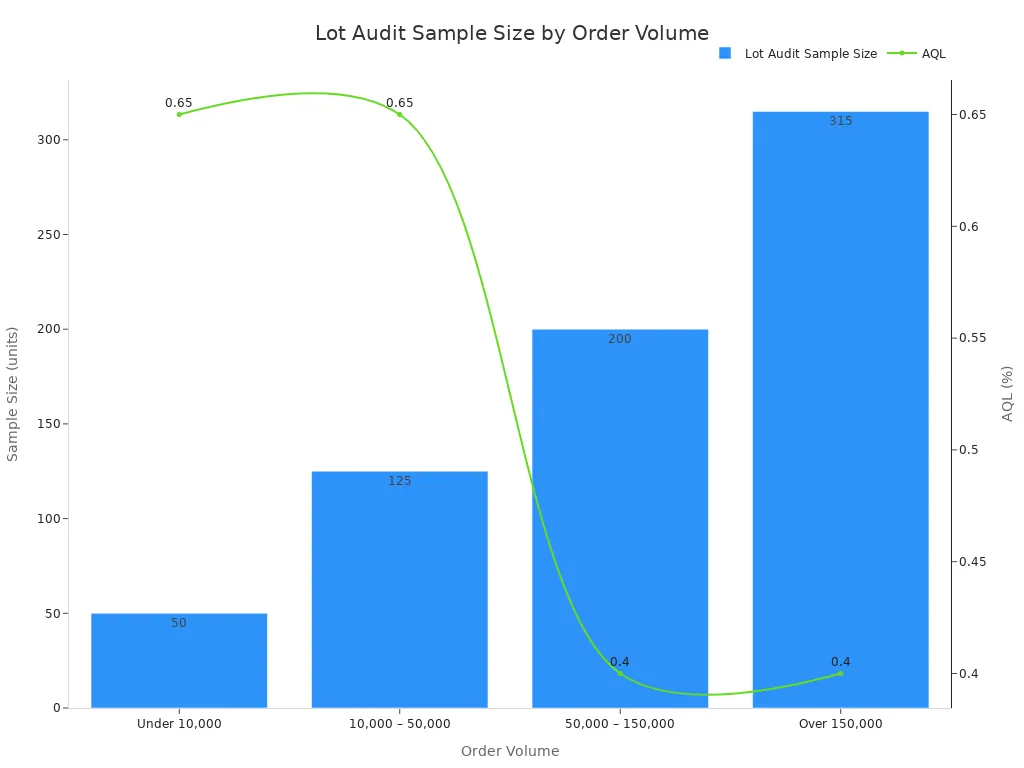
The inline leak test runs on every unit during production. The documented station pass rate must be 99.5% or higher. Your lot audit sample follows ANSI/ASQ Z1.4, General Inspection Level II. This standard gives you a sample size that is statistically valid.
Now sort the defects you find. You put every issue into one of three groups. This sorting decides what you do next.
|
Defect Category |
Definition |
Examples |
|---|---|---|
|
Critical |
Safety issues with zero tolerance; triggers full-lot rejection and regulatory hold. |
Heavy metals above limits, battery safety problems. |
|
Major |
Functional issues that make the product unusable or unsellable; triggers chargeback or lot remedy. |
Leakers, dead on arrival (DOA), draw resistance outside specification. |
|
Minor |
Cosmetic issues that do not affect function; triggers a credit. |
Visible cosmetic defects that are not sellable. |
Critical defects stop everything. You reject the whole lot. You put a regulatory hold on it until you fix the safety issue. Major defects make the product unusable. You charge the supplier or ask for a fix. Minor defects do not affect function. You ask for a credit instead of a full return.
AQL and Critical Checks
AQL stands for Acceptable Quality Limit. This number tells you the most defective units you can accept in a lot. The table above shows AQL values of 0.65 or 0.40 depending on your order size. A lower AQL means stricter quality standards. You reject the lot if the defect rate goes above this limit.
Your QC checklist for wholesale buyers must include specific critical checks on every sampled unit. These checks make sure the device works as it should.
Check that the device capacity matches the 2-gram spec. Look at the airflow design for smooth draws. Confirm the battery size can handle the full fill volume. Test if it works with your oil thickness. Thicker oils may have trouble with some wicking setups.
Check authenticity using scratch-and-reveal codes on the packaging. Look at build quality for clean threads, sharp logos, and tight connections. Check battery health indicators. Watch for error flashes that show internal problems. Clean the charging port of debris. Make sure the cable fits snugly.
Inspect the connections. Clean the 510 threads and pod pins. These contacts must fire every time. Check the coil condition by measuring resistance. Match the oil ratio to the device specs. A 50/50 or 60/40 blend works well for most pen-style devices.
Look at the O-rings and gaskets at the tank base and top. Check for cracked glass or damaged seals. Look for leaks by holding the device upright and watching for liquid. Test the airflow ring. Clear debris from the vents if clogged. Fix gurgling sounds by flicking the device to remove extra liquid.
Record every finding. Write down the lot number, sample size, and defect count. Calculate the defect rate. Compare it to the AQL limit. This data guides your decision on what to do. A systematic inspection plan turns a messy process into a repeatable quality check.
Battery-Containing AIO QC Checks
The LUIGI V9 has a built-in battery. This battery makes your QC checklist harder. You must check electrical safety and connection quality on every sample unit. These checks keep your customers safe and protect your brand from legal trouble.
Voltage and Connection Integrity
You need to make sure the battery gives steady power. Use a multimeter to check the output voltage. Compare the reading to the battery's rated capacity. A much lower reading means partial discharge, internal damage, or aging. This test shows if the unit can power the full 2-gram fill.
Test internal resistance with a battery analyzer. Higher resistance means lower efficiency, less vapor, and more heat. These problems shorten battery life and ruin the user experience. Write down every reading on your inspection sheet.
Connection quality is just as important. Follow these steps to check clean, reliable contacts:
-
Clean the connection point every two weeks. Wet a cotton swab with 91% or 99% isopropyl alcohol. Wipe the inside threads and circular center pin well.
-
Adjust the center pin if you see a "no atomizer" error. Use a small paperclip or toothpick to gently lift the pin up by a tiny bit.
-
Follow the tension rule. Turn the cartridge only until finger-tight. Over-tightening crushes rubber O-rings and seals, causing lasting damage and leaks.
Over time, small amounts of e-liquid or water can build up on the 510 threading or gold-plated pins where the tank meets the battery. This can cause a "check atomizer" error or uneven firing. Every few days, use a cotton swab with a little rubbing alcohol and wipe these connection points to keep a clean electrical circuit.
Watch for voltage drop issues during testing. When battery voltage drops below working levels, the device flashes to tell you to recharge. This is normal. But flashing can also mean connection problems between the battery and pod. Check for wrong installation, dirt on contacts, or inside part failure.
Safety Certification Verification
Battery safety certifications keep your customers safe from electrical, fire, and mechanical risks. You must check these credentials before accepting a shipment. Look for these key certifications:
-
UL (Underwriters Laboratories): Tests for electrical, fire, and mechanical risks, making sure the battery meets strict safety standards.
-
CE (Conformité Européenne): Required mark for products sold in the European Economic Area, showing they follow health, safety, and environmental rules.
-
FCC (Federal Communications Commission): Certification for electromagnetic interference and radio frequency emissions, making sure the device works within legal limits.
Industry safety rules include overcharge protection, short-circuit prevention, thermal cutoff, and current regulation. These features keep users safe from danger. Ask your supplier for documents that show these protections are in the LUIGI V9.
Bestvapesupply gives safety documents for their battery units. Ask for these records before you finish your order. Check that the certifications match your target markets. This step stops regulatory problems and builds customer trust in your brand.
Shipment Disposition Options
Your inspection ends with one of three outcomes: pass, fail, or conditional. A pass means you accept the lot and move it to inventory. A fail means you reject the entire shipment. A conditional outcome means you accept part of the lot while the supplier fixes the rest. Each outcome requires specific documentation and a clear action plan.
Documentation and Lot Tracking
You must link every disposition decision to a specific lot. Without proper documentation, you cannot prove what you accepted or rejected. Three documents form your tracking foundation.
|
Document |
Primary Function |
Required Evidence for Lot Tracking |
|---|---|---|
|
Certificate of Analysis (COA) |
Documents what was tested |
Sample identity, test/analyte, method reference, result, unit, applicable limit, issue date, authorization |
|
Certificate of Conformity (CoC) |
Declares conformity to a specification |
Issuer, object/scope, referenced standard/contract, declaration basis, date, authorized approval |
|
Inspection/Test Report |
Records actual inspection findings |
Lot/sample identity, revision, characteristic, method/equipment reference, actual result, limit, disposition |
You must connect these documents to the specific hardware revision and lot number on your receiving table. A COA without a lot number has no value. An inspection report without a revision date cannot guide future orders. Store these records with your shipment files. You will need them for audits, supplier disputes, and regulatory reviews.
Handling Rejected Shipments
A rejected shipment needs a disposal plan before you contact the supplier. You cannot leave defective hardware sitting in your warehouse. Follow this procedure to handle rejected lots safely.
-
Review the DDP scope to identify the party responsible for the import entry and whether customs brokerage, duties, taxes, and excise are included.
-
Check the exact product and destination eligibility to confirm the products can enter the market and who will manage the import entry.
-
Determine how customs inspection, rejected entry, return, destruction, or redelivery will be charged.
-
Verify whether the final-mile provider accepts the cargo; if not, change the delivery plan before export and confirm a commercial warehouse that accepts the cargo.
-
If the product, battery, liquid, or packing changes at any stage, review the route again.
-
If the DDP route is not suitable, consider standard air or sea freight with the customer's own importer and customs broker for a clearer solution.
You also need a disposal strategy for rejected units. Major carriers like UPS, FedEx, and DHL refuse to ship vaping products to residential addresses. You cannot redirect rejected hardware through them. Regional carriers may cover some areas, but delivery deserts exist where no carrier operates. For international shipments, customs officials may seize or destroy rejected hardware that does not meet local labeling rules.
Your disposal options include:
-
Establish a dedicated, clearly labeled collection point with terminal protection and segregation of damaged items.
-
Contract with a specialized hazmat transport company that provides approved packaging and scheduled pickup.
-
Use battery or e-waste recycling vendors with documented downstream controls and chain-of-custody documentation.
-
Comply with RCRA universal waste rules for training, labeling, and accumulation limits.
-
Follow DOT's 49 CFR §173.185 for lithium battery transport with correct UN numbers and packaging.
-
Implement customer return SOPs that prohibit consumer mail-back and escalate damaged items into a separate workflow.
Document every disposal action. Record the vendor, date, and quantity. This trail protects you if regulators ask questions later.
QC Data Trend Analysis
Your inspection records are more valuable than just one shipment choice. Each lot you check gives you data. That data shows patterns. You can spot weaknesses before they become expensive failures. You can compare suppliers, batches, and production dates. You can turn raw numbers into a smarter buying plan.
Tracking Recurring Defects
You need a system to organize your inspection results. Track specific numbers for every shipment you get. The table below shows the historical data that matters most for vape hardware quality.
|
Historical Data to Track |
Specific Metric |
Quality Implication |
|---|---|---|
|
On-time delivery history |
Past on-time delivery rate (e.g., percent of orders shipped on time) |
Shows if the supplier can handle growth and be reliable. A factory with high output but late deliveries is not a good long-term partner. |
|
Batch testing results |
Third-party lab results for heavy metals (Pb/Cd/As/Hg) per batch, tested under conditions that copy real use |
Makes sure safety and consistency are met across all production runs. |
|
Coil resistance consistency |
Difference in resistance across sampled batches (target ±0.05Ω) |
Big difference means uneven heating and vapor, which hurts user experience. |
|
Clog rate history |
How often clogs happen from repeated draws at different temperatures and thicknesses |
Finds repeating design or material problems, especially for thick liquids. |
|
Sample testing process maturity |
Whether there are structured pre-production sample (PPS) and golden sample sign-off records |
Shows the supplier's commitment to quality control and process discipline. |
You should test each batch before sending it out. This step makes sure no contaminated product reaches your market. You should review past data for trends. This review lets you spot repeating issues or improvements over time. You should change sourcing or production methods based on trend analysis. These data-driven changes stop future defects. You should keep clear records. These records provide an audit trail and help track product reliability over time.
Track defects by supplier and by batch number. You might notice one supplier produces more leakers than another. You might see clog rates go up during certain production months. These patterns tell you which suppliers need more oversight. They also tell you which batches need extra checking before you accept them.
Updating the Checklist
Your QC checklist for wholesale buyers must change over time. A fixed checklist misses new problems. You should review your inspection data every three months. Look for defect types that show up again and again. Add new checks to catch those issues early.
For example, if your data shows clog rates going up in winter months, add a cold-temperature draw test to your checklist. If one supplier always fails coil resistance checks, make your sampling plan stricter for that supplier. You might increase sample sizes or ask for extra documents.
Share your findings with your suppliers. Send them your trend reports. Ask them to fix repeating issues at the source. A good supplier will change their production process. A poor supplier will make excuses. Your data tells you which type you are dealing with.
Update your checklist after every major finding. Write down the date of each revision. Note why you made the change. This revision history shows your quality system is active, not fixed. It also protects you during audits. You can show that you track problems and fix them.
Your next shipment is your first test. Use this checklist to pass it.
This QC checklist for wholesale buyers is your risk management tool. It protects your capital, your brand, and your customer relationships. Every inspection step you follow prevents costly returns and damaged reputation.
Systematic quality control directly impacts your bottom line. Each defective unit you catch before shipment saves you replacement costs, shipping fees, and lost customer trust. Your profit margin depends on catching problems early.
Download this checklist now. Print it. Keep it at your receiving dock. Apply it to every shipment without exception. You control your supply chain quality through consistent, documented inspection.
Your next shipment is your first test. Use this checklist to pass it.
FAQ
What is the most common defect to watch for?
Leaks cause the most complaints. You check every sampled unit by holding it upright and watching for liquid. A single leaker in your sample means you should inspect the whole lot more carefully.
How do you reject a shipment properly?
You document every defect with photos and lot numbers. You contact the supplier with your evidence. You arrange for disposal through a hazmat vendor or e-waste recycler. Never return defective hardware through standard carriers.
How often should you update your QC checklist?
Review your inspection data every three months. Look for defect patterns. Add new checks when you see the same problem repeat. A living checklist catches new issues before they become expensive problems.
What certifications matter for the battery?
Look for UL, CE, and FCC marks. These show the battery meets safety standards for electrical, fire, and mechanical risks. Ask your supplier for the actual certification documents, not just claims.
Is LUIGI V9 filled with oil?
The hardware discussed in this article is empty hardware only. No oil, nicotine, cannabis, concentrate, e-liquid or other filled consumable product is included.
0users like this.
-
Posted on Tuesday, 25 August 2026
-
Posted on Saturday, 05 September 2026
-
Posted on Friday, 16 October 2026
0comments
- Empty Vape Hardware
- OEM vape hardware
- Dual Chamber Vape Hardware
- Thick Oil Vape Hardware
- dual chamber vape hardware
- Disposable Vapes
- Packman 4G
- ACE Ultra
- ACE Ultra Vape Pen
- Empty Disposable Hardware
- postless vape hardware
- OEM Manufacturing
- Rechargeable vape hardware
- Dual Chamber Hardware
- 10/10 Boys Switch
- Fryd dual chamber vape
- Fryd vape pen
- Fryd 2g
- Fryd disposable 2ml
- DRANKS DUAL Disposable Vape
- dual flavors
- Vape Battery
- HITZ ZEUS EDITION 2G
- HITZ Infinity Blue 2ML Pens
- HITZ Infinity
- HITZ ZEUS
- Dual Chamber Vape
- 2g Disposable
- Dual Tanks vape pen
- Disposable Vape Pens
- Wholemelt Phase Five Switch Vapes
- Wholemelt Switch Vapes 2G
- Wholemelt Vapes 2G
- DUAL Disposable Vape
- 2ML Dual Tanks
- 2G Disposable Vape
- MUHA MEDS Gen
- Splitz Vape Pen
- Splitz Vapes 2G
- Muha meds 2G
- Splitz 2ml
- TURNONE 2ML Empty Vape Hardware
- TURNONE 2ML
- customization
- 2ML Empty Vape
- ACE 2ml Vapes
- Packman 2ml vapes
- Whole Melt Candy Shop Switch 2G
- Whole Melt Candy Shop Switch
- dual-chamber
- OG Cake
- Cake 2ml vapes
- OG Cake Vape Pen
- Cake 2G Vapes
- MUHA MEDS Gen 3
- Muha meds 2ml
- Muha meds Switch
- Muha Meds 2.5G
- Sherbinskis Quattro 2G
- activation failure
- FAVORITES Disposable 3G
- Disposable 3G
- FAVORITES Disposable
- FRYD SWITCH DISPOSABLE 2G
- FRYD Switch 2G
- disposable vape
- FRYD 2g
- Dual Chamber Pens
- HITZ ZEUS Edition 2G
- MUHA MEDS Melted Diamonds vape
- HITZ ZEUS 2G
- MUHA MEDS Melted Diamonds 3.5G
- Push V2 Summer Vape Pen
- Push V2 Summer Vape Switch
- Push 2G Vape Switch
- Push 2G Switch
- Boutiq Switch ORB V5 Triple Tank
- Boutiq Switch ORB V5
- Boutiq Switch
- Triple Tank Vape
- Packman Partyboyz Disposable Vape
- Packman Partyboyz 3G
- Packman vape pen
- Packman 2g vapes
- Raw Garden Adjustable Voltage
- Raw Garden 2G
- Raw garden Vapes
- Raw garden vape pen
- MUHA MEDS Empty Vape Pen
- SHERBINSKIS QUATTRO 2G
- MUHA MEDS 2g Vape Pen
- dual chamber Vape Pen
- Muha Meds empty vape
- 3.5ML Muha Meds
- Muha Meds 2ml
- Crybaby Trios 3G
- Crybaby Trios 3G Empty Disposable Vape
- disposable vape hardware
- Muha Meds Gen 3 empty hardware
- HitZ Infinity 2G empty hardware
- Slugger Hit 3G Triple-Chamber Vape
- Multi-Flavor Hardware
- disposable empty hardware
- Airflow Blockage
- Thick Oil Empty Vape Hardware
- thick oil vape cartridge
- OEM empty vape hardware
- DONUTS Switch GEN 2 E
- 2ML Dual Chamber Vape
- DONUTS Switch Pen 2ML
- Boutiq Switch V5
- Boutiq Dual Chamber
- Empty Vape Hardware Quality Control
- LUIGI V9 2G Empty Vape Hardware
- Donuts Gen 2 Dual Chamber
- Sprinklez Disposable Vape
- Sprinklez Disposable 2G
- Muha meds glass jars
- ACE Glass jars
- custom packaging
- UNIPUFF SWITCH DISPOSABLE 2G
- Muha Meds GTA edition
- Alien Labs Dual Empty Disposable 2G
- Alien Labs Dual
- vape pen overheating
- vape hardware troubleshooting
- vape battery overheating
- Raw Garden Vape Pen
- Ceramic Coil
- rechargeable disposable
- 2ML Empty Vape Hardware
- OG Cake Legendary Edition
- CRYBABY TRIOS 3 IN 1
- Multi-Chamber Vape
- manufacturing process
- BIG CHIEF DUO V3 Empty Vape Hardware
- Single Chamber Vape Hardware
- Sluggers Hit dual chamber
- OEM vape manufacturer
- 510 Thread Vape Cartridge
- Dual chamber
- LED screen devices
- All-In-One Vape Hardware
- Dual Vape Hardware
- 510 cartridge hardware
- ceramic vape cartridge
- OEM cartridge supplier
- ACE Ultra 2ml Dual Chamber
- Donuts Switch V4 Dual Chamber
- Single-Chamber Disposables
- Ceramic Coil Guide
- Thick Oil Hardware
- CALI CLEAR 2G
- Oil flow problems
- Ace Ultra Switch
- Ace Ultra Premium Empty Vape Hardware
- LED screen vape hardware
- Smart vape hardware
- Voltage Control
- Buzz Bar 3G Switch
- 10/10 Boys Single Flavor
- multi chamber vape hardware
- Sluggers Dual Chamber
- SMOOTHIE BAR BLEND 3.0 Switch
- Switch Empty Vape Hardware
- Multi-Chamber Empty Vape Hardware
- vape hardware airflow
- multi-chamber hardware leakage
- BESOS 3 Flavors Switch
- BESOS 3 Flavors Switch Empty Vape Hardware
- Slugger Hit 3 tanks SWITCH 3G
- 10/10 Boys Switch clogging
- SHERBINSKIS QUATTRO 2G dual chamber vape hardware
- Packman x Jeeter DUAL CHAMBER Vape Hardware
- 2G disposable vape
- Empty Triple-Chamber Vape Hardware
- OEM triple chamber vape hardware
- postless dual-chamber vape hardware
- ceramic vape hardware
- triple chamber vape hardware
- 1mL + 1mL dual-chamber vape
- dual-chamber empty vape hardware
- Khalifa Kush Switch
- HOLLOWTIPS 2G vape hardware
- HOLLOWTIPS 2G empty vape
- Hollow Tips 2G empty vape
- Hollowtips V1 empty vape hardware

Your cart is currently empty.