
-
 Shopping Cart (0)
Cart Total:
Your cart is currently empty..
Vape Hardware Engineering
Thick Oil Empty Vape Hardware Guide: Ceramic Coil, Airflow and QC Review
- Friday, 21 August 2026
- 0
- 266
- 0
Choosing empty vape hardware for thick oil applications requires a balance between oil viscosity compatibility, airflow design, heating structure, and sealing performance.
Different oil consistencies require different internal designs. Intake size, ceramic heating elements, airflow pathways, and preheat functions all influence hardware performance during production and quality testing.
This guide reviews thick oil empty vape hardware from a B2B manufacturing perspective, helping wholesalers, distributors, and private label brands understand the key factors before selecting hardware suppliers.
Key Takeaways
- Thick oil hardware requires proper viscosity compatibility between intake structure, airflow pathway and heating system.
- Ceramic heating elements help provide consistent heat distribution for different oil viscosity applications.
- Hardware design factors such as intake size, cartridges with big intake holes, sealing structure and airflow balance affect overall reliability.
- Preheat functions can support better oil-flow management in cold environments.
- OEM buyers should verify hardware specifications, QC standards and sample testing before bulk production.
Thick Oil Vape Viscosity Explained

What Viscosity Means for Vaping
Viscosity, defined as a fluid's resistance to flow, varies significantly among different cannabis extracts.
This resistance to flow directly impacts your vaping experience. It affects how well the oil moves through your cartridge. It also changes how quickly the oil reaches the heating element. If oil is too thick, it cannot wick fast enough. This leads to problems like dry hits. When the coil heats dry residue instead of fresh oil, you get a burnt taste.
Different cannabis oils have different thickness levels. For example, pure THC distillate can be very thick, ranging from 100,000 to 500,000 cP. Oils with terpenes, like THC/CBD with 5–10% terpenes, are less thick, from 10,000 to 100,000 cP. Live resin and rosin oils also have a wide range, from 20,000 to 150,000 cP. Cut oils, which use thinning agents, are much thinner, from 100 to 10,000 cP. This table shows common cannabis oil types and their viscosity ranges:
| Cannabis Oil Type | Viscosity Range (cP) |
|---|---|
| Pure THC Distillate | 100,000 – 500,000 |
| THC/CBD with 5–10% Terpenes | 10,000 – 100,000 |
| Cut Oils (MCT, PG, or VG blends) | 100 – 10,000 |
| Live Resin / Rosin Oils | 20,000 – 150,000 |
How Viscosity Impacts Hardware
External factors like temperature greatly affect oil viscosity. Cold temperatures make oil much thicker. This can cause issues like clogging. When oil is too thick, it struggles to move through the small parts of your vape hardware. This makes it hard for the coil to get enough oil.
On the other hand, too much heat can make oil too thin. This increases the risk of leaks. Heating oil to 80–100 °C (176–212 °F) during filling can reduce its thickness by 80% or more. However, in your vape, high heat can cause problems. The air inside the tank expands when heated. This pressure pushes the now-thinned liquid. It forces the oil through the coil and out of the bottom of the tank. This can lead to messy leaks.
Here is a chart showing the viscosity ranges for different cannabis oils:
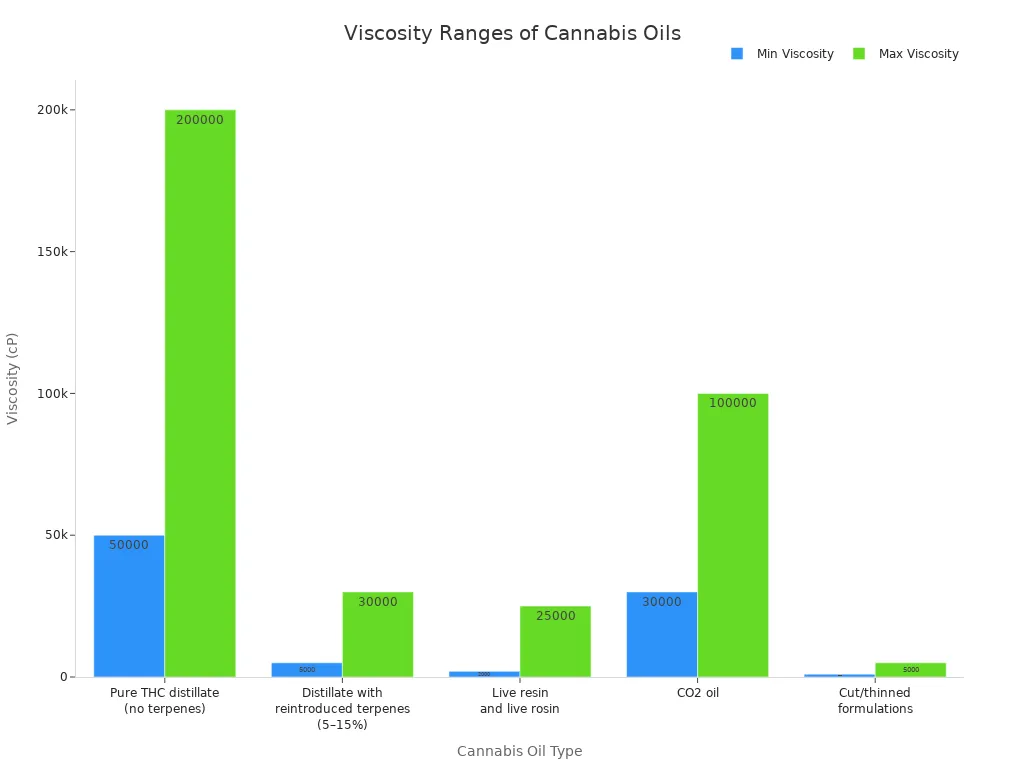
For a smooth Thick Oil Vape experience, you need hardware that matches your oil's viscosity. As oil gets thicker, you need larger intake ports and more porous coils. This helps the oil wick properly. For example, live resin with moderate viscosity flows easily through ceramic micropores. However, very thick oils like rosin need coils with optimized pore size and oil pathways to prevent clogging.
Key Hardware for Thick Oil Vaping
Picking the right equipment is very important for a good vaping experience. These hardware choices are key to stopping common problems like dry hits and clogs, especially with very thick oils. You need special features to make sure your thick oil flows well and heats correctly.
Intake Aperture Size
The intake aperture size is a very important part of your vape cartridge. This is the small hole where the oil goes into the heating part. The size of this hole directly changes how easily oil flows to the heating part. Thicker oils need bigger holes for good flow and wicking. If the hole is too small, the thick oil cannot move fast enough. This makes the coil dry out and causes a burnt taste. For very thick oils like live rosin, you should look for an intake hole that is 1.6 to 2.0 mm wide. If you are using very thick winterized oil, a 2.0 mm or bigger hole is best. Bear Rootz, for example, suggests a 2.0 mm intake hole for thick oils like rosin and distillate. They stress that a large intake is needed for these thick oils. A bigger hole makes sure thick oil flows freely to the coil. This stops the coil from getting too little oil and overheating. On the other hand, smaller holes stop thinner oils from leaking. Finding this balance is key to stopping both dry hits and leaks.
Heating Element Types
The type of heating part in your cartridge also plays a big role in how well thick oils turn into vapor. Ceramic cores work very well for both thick and thin oils. They are known for holding heat very well. This makes them very popular in cartridges made for thicker oils, like rosin. Ceramic cores spread heat evenly across the whole coil. This stops hot spots and burnt hits. When heat is spread evenly, it makes sure the oil is always wet. This is important for thick oils that need even heat to wick right without burning.
Ceramic coils have many benefits over other materials like quartz. They soak up and hold very thick oil without clogging. They also stop clogs and dry hits, which are common problems with thick oils. You will find that ceramic coils often last longer than quartz coils. They work very well with thick cannabis oils because they keep heat steady with little battery use. This steady, even heating turns the material into vapor completely. Ceramic coils make thick, steady clouds that quartz often cannot match. They also make the thickest vapor among many heating materials. A good ceramic core makes sure oil flows steadily. This keeps the coil wet and stops wicking problems. The right battery power is also important. A good battery gives steady power to the heating part. This stops overheating, which can burn thick oil. Matching the voltage to your oil's thickness, maybe lower for thick oils, makes sure it turns into vapor perfectly. This stops overheating and dry hits by matching heat with how the oil flows. Hardware made for thick oils often has a strong wicking design, like bigger wicking paths. This helps keep the coil wet and directly fixes the slow wicking of very thick oils, lowering the chance of dry hits.
Making Your Vaping Better
How to Use Voltage and Temperature
You can make your vaping much better by controlling the voltage and temperature. Thicker oils often need higher voltage or pre-heating. This makes them thinner for a short time. But you must use controlled heat. This stops the oil from burning, which tastes bad. For strong THC oil (85%+), a good voltage is 3.0V to 3.4V. If you go above 3.6V on normal ceramic coils, it will burn. Rosin or solventless oil needs a lower range, from 2.4V to 2.8V. The waxy parts in these oils burn fast above 2.8V. You should not use preheat or use it very little for these oils. For all thick oils, 2.4V to 3.6V works. Above 3.6V, the good parts break down, the waxy parts burn, and it tastes burnt.
Your voltage choice also changes the flavor. A range of 2.0V to 2.4V keeps the flavor good and gives smooth puffs with cooler, lighter vapor. The 2.4V to 2.8V range gives good flavor and does not hurt your throat much. This makes it a good choice for every day. At 2.8V to 3.2V, you get warmer, thicker vapor, but the flavor might be a little less. Voltages above 3.3V often make a burnt taste and hurt your throat, even though they make big clouds. Live rosin and other sensitive oils can taste burnt if the voltage is too high. Too much heat ruins their delicate flavors. For thick oil (high-VG), it needs to be 220–240°C to turn into vapor well. To stop it from breaking down, a safe range is 200–230°C. Going over 240°C makes it turn to caramel and harms the coil. Temperatures above 250°C create bad chemicals. This means you must stay below 240°C.
What Preheat Does
The preheat button is very helpful for thick oils. It makes the oil thinner so you can take smoother puffs. This feature uses a low voltage, usually 1.8V to 2.0V, for 10 to 15 seconds. This voltage is much lower than what you use for regular vaping. This low power creates gentle warmth. It directly makes thick oils like live resin, rosin, and heavy oil thinner. When these oils are at room temperature, they are very thick. They cannot easily flow into the small holes of the vape.
Thick oils at room temperature can be as thick as cold honey. This stops them from flowing into the small holes of the vape. When the oil cannot reach the heating part, the coil heats up dry. This causes a burnt taste and can damage the vape. Preheating thins the oil just enough. This makes sure it soaks into the wick or ceramic heating part correctly. This lowers how thick it is and helps it flow well.
The preheat warms the oil just enough to thin it out. This lets it move freely and soak the heating part before you start vaping at full power. For regular oil cartridges with ceramic or cotton wicks, preheating for 3–6 seconds is common. For thick oil or on a cold day, you might need 5–8 seconds, possibly up to 2.4V. If your cartridge was left in a cold car on a cold morning, a 6-second preheat at 2.2V can work well.
Preventing Thick Oil Vape Issues
You can avoid many common problems with thick oil vapes by using good practices. These practices help you enjoy a smooth and consistent experience.
Strategies for Clog Prevention
Proper storage is very important for preventing clogs. You should always store your cartridges upright. This stops oil from settling in the mouthpiece, which is a main cause of blockages. Upright storage also keeps the oil in contact with the heating element. This helps with consistent vaporization and lowers the risk of clogs. Keep your vape at room temperature in a dark place. You should avoid putting it in the refrigerator or freezer. Cold temperatures make oil thicker, which can lead to clogs. Also, cold can cause condensation, adding moisture to your vape. Extreme heat also causes problems. It thins the oil, which can lead to leaks and residue buildup. For storage longer than a week, take the cartridge off the battery. This prevents pressure on the connection and slow electrical discharge. When you are not using your vape, cap the mouthpiece. This protects it from dust and debris. Storing your vape upright in a cool, dry place helps keep the oil consistent and prevents leaks. Avoid storing your vape flat or in direct sunlight. This can cause oil to build up and clog the device.
Your vaping technique also plays a big role in preventing clogs. Inhaling too forcefully can pull too much oil into the mouthpiece. This leads to clogs. Instead, take slow, steady draws from your vape. Taking frequent, short draws can also make things worse. It increases condensation and moisture buildup. Longer, more consistent draws help reduce this issue. Try taking shorter, gentler hits instead of long, hard draws. This helps prevent flooding the heating chamber with too much oil and creating more condensation.
Troubleshooting Dry Hits & Leaks
Dry hits are a common problem. They happen when the wick does not get enough oil. Several things can cause dry hits. Cold temperatures make the oil too thick to heat and vaporize properly. This results in a tight or dry hit. Thick oils or those with plant materials need more heat. Without enough heat, they can produce a sticky or burnt flavor. Blocked airflow, from buildup or poor cartridge design, can also cause harsh, dry pulls. A low or weak battery can lead to uneven heating. This causes only partial oil vaporization and changes the taste. If your cartridge is nearly empty, the wick cannot stay saturated. This leads to dry hits. Storing the cartridge on its side allows oil to move away from the wick. It can also trap air pockets. This creates conditions for dry hits even if the cartridge is full. Once a wick burns from a dry hit, the charred material permanently affects the flavor. You will need to replace the cartridge.
Leaks are another frustrating issue. You can fix a leaky cartridge with a few steps. First, clean the connections and airway. Remove the cartridge and wipe away any excess concentrate. Attach the cartridge carefully. Tighten it firmly, but do not overtighten. Overtightening can strip threads or crack the glass. Always store the cartridge upright when you are not using it. This prevents oil from seeping into the mouthpiece or bottom. If leaks continue, replace damaged parts like worn o-rings or seals on the battery. You might need to replace the cartridge itself. Adjust your usage and battery settings. Use the recommended voltage to avoid overheating. Take slower draws to prevent flooding. Avoid leaving cartridges in hot cars. Heat thins the oil and increases the risk of leaks. For all-glass cartridges, leaks often happen when the glass-to-atomizer connection loosens. This can be from overtightening onto the battery or repeated threading. To prevent this, always hold the cartridge by the lower black ring, not the glass. Do this when you screw it on or off the battery. This keeps the connection tight and stops the glass from separating from the atomizer.
Picking Cartridges & Batteries
Picking the right cartridges and batteries is very important for a smooth and fun Thick Oil Vape experience. You need parts made to handle thick oils well. Good quality parts stop common problems and work well every time.
Cartridge Design for Thick Oils
How your cartridge is made greatly affects how well thick oils turn into vapor. The size of the intake hole is very important. A 2.0 mm intake will clog a live rosin cartridge, no matter what it's made of. Instead, a 2.5 to 3.0 mm intake with matching airflow will work smoothly. This shows how cartridge design changes airflow by controlling where and how much oil goes into the heating part. Bigger intakes make it easier for thick oils to flow and stop clogs. Older cartridge designs had a narrow center post that made it hard to draw air. For thick oils, this caused constant clogging and poor vapor because the oil couldn't get into the heating part well. The size and shape of the center post directly affect how hard it is for air to flow and how well thick oils can move. When you look for good vape cartridges, check out trusted stores like bestvapesupply. They sell products made with these important features in mind.
Battery Power & Compatibility
Your battery choice is just as important as your cartridge. A good 510 thread battery gives the power and features needed for thick oils. Being able to change the voltage is key; thick oil works best between 2.4-3.3V. A range of 2.0-4.2V with small steps is a good idea. Battery size also matters. You might pick 300-400 mAh for light use, 500-650 mAh for daily use, or 700-900+ mAh for heavy use.
Thicker oil mixes often need the middle to higher voltage settings. If your cartridge is cold or the oil looks thick, start at the next voltage step for the first 1–2 puffs. Then, go back to your usual setting. Sometimes, it takes longer for thick oils to start working because they are hard to wick and heat. Leaks can happen if the oil doesn't heat enough. Instead of turning into vapor, it gathers around the intake holes. Cold weather makes oil thicker. If you are outside in winter and the cartridge isn't working, moving up one voltage step often fixes it. A preheat mode on some batteries gently warms the oil without fully turning it into vapor. This helps thick or cold cartridges get ready without burning. For good 510 thread batteries with these features, bestvapesupply has many options.
You now know that good thick oil vaping means understanding how thick your oil is. You also know how to pick the right hardware for it. We talked about important hardware choices. These include the correct intake size and good heating parts. We also discussed smart voltage control and helpful preheat settings. A setup that fits your oil will give you a smooth experience every time. You will get full flavor and no clogs. Use this information to make your vaping better. You can avoid common problems and enjoy every time you vape. This guide helps you make smart choices for better results.
FAQ
Why does thick oil require special vape hardware design?
Thick oil require optimized oil-flow pathways, heating structures and intake designs. Hardware compatibility should be evaluated through sample testing before mass production.
What voltage should I use for thick oils?
Use 2.4V to 3.6V for most thick oils. Rosin or solventless oil needs a lower range, 2.4V to 2.8V. Higher voltages can burn the oil and ruin the flavor. Adjust your voltage for optimal vapor and to prevent burning.
How does preheat help with thick oils?
Preheat gently warms thick oil. This makes it thinner. It helps the oil flow into the heating part. This prevents dry hits and ensures smooth draws. It is especially useful for cold cartridges or very thick extracts.
What heating element works well for thick oil hardware?
Ceramic cores heating elements are commonly used because they provide stable heat distribution and support consistent vaporization across different viscosity applications.
0users like this.
0comments
- Empty Vape Hardware
- OEM vape hardware
- Dual Chamber Vape Hardware
- Thick Oil Vape Hardware
- dual chamber vape hardware
- Disposable Vapes
- Packman 4G
- ACE Ultra
- ACE Ultra Vape Pen
- Empty Disposable Hardware
- postless vape hardware
- OEM Manufacturing
- Rechargeable vape hardware
- Dual Chamber Hardware
- 10/10 Boys Switch
- Fryd dual chamber vape
- Fryd vape pen
- Fryd 2g
- Fryd disposable 2ml
- DRANKS DUAL Disposable Vape
- dual flavors
- Vape Battery
- HITZ ZEUS EDITION 2G
- HITZ Infinity Blue 2ML Pens
- HITZ Infinity
- HITZ ZEUS
- Dual Chamber Vape
- 2g Disposable
- Dual Tanks vape pen
- Disposable Vape Pens
- Wholemelt Phase Five Switch Vapes
- Wholemelt Switch Vapes 2G
- Wholemelt Vapes 2G
- DUAL Disposable Vape
- 2ML Dual Tanks
- 2G Disposable Vape
- MUHA MEDS Gen
- Splitz Vape Pen
- Splitz Vapes 2G
- Muha meds 2G
- Splitz 2ml
- TURNONE 2ML Empty Vape Hardware
- TURNONE 2ML
- customization
- 2ML Empty Vape
- ACE 2ml Vapes
- Packman 2ml vapes
- Whole Melt Candy Shop Switch 2G
- Whole Melt Candy Shop Switch
- dual-chamber
- OG Cake
- Cake 2ml vapes
- OG Cake Vape Pen
- Cake 2G Vapes
- MUHA MEDS Gen 3
- Muha meds 2ml
- Muha meds Switch
- Muha Meds 2.5G
- Sherbinskis Quattro 2G
- activation failure
- FAVORITES Disposable 3G
- Disposable 3G
- FAVORITES Disposable
- FRYD SWITCH DISPOSABLE 2G
- FRYD Switch 2G
- disposable vape
- FRYD 2g
- Dual Chamber Pens
- HITZ ZEUS Edition 2G
- MUHA MEDS Melted Diamonds vape
- HITZ ZEUS 2G
- MUHA MEDS Melted Diamonds 3.5G
- Push V2 Summer Vape Pen
- Push V2 Summer Vape Switch
- Push 2G Vape Switch
- Push 2G Switch
- Boutiq Switch ORB V5 Triple Tank
- Boutiq Switch ORB V5
- Boutiq Switch
- Triple Tank Vape
- Packman Partyboyz Disposable Vape
- Packman Partyboyz 3G
- Packman vape pen
- Packman 2g vapes
- Raw Garden Adjustable Voltage
- Raw Garden 2G
- Raw garden Vapes
- Raw garden vape pen
- MUHA MEDS Empty Vape Pen
- SHERBINSKIS QUATTRO 2G
- MUHA MEDS 2g Vape Pen
- dual chamber Vape Pen
- Muha Meds empty vape
- 3.5ML Muha Meds
- Muha Meds 2ml
- Crybaby Trios 3G
- Crybaby Trios 3G Empty Disposable Vape
- disposable vape hardware
- Muha Meds Gen 3 empty hardware
- HitZ Infinity 2G empty hardware
- Slugger Hit 3G Triple-Chamber Vape
- Multi-Flavor Hardware
- disposable empty hardware
- Airflow Blockage
- Thick Oil Empty Vape Hardware
- thick oil vape cartridge
- OEM empty vape hardware
- DONUTS Switch GEN 2 E
- 2ML Dual Chamber Vape
- DONUTS Switch Pen 2ML
- Boutiq Switch V5
- Boutiq Dual Chamber
- Empty Vape Hardware Quality Control
- LUIGI V9 2G Empty Vape Hardware
- Donuts Gen 2 Dual Chamber
- Sprinklez Disposable Vape
- Sprinklez Disposable 2G
- Muha meds glass jars
- ACE Glass jars
- custom packaging
- UNIPUFF SWITCH DISPOSABLE 2G
- Muha Meds GTA edition
- Alien Labs Dual Empty Disposable 2G
- Alien Labs Dual
- vape pen overheating
- vape hardware troubleshooting
- vape battery overheating
- Raw Garden Vape Pen
- Ceramic Coil
- rechargeable disposable
- 2ML Empty Vape Hardware
- OG Cake Legendary Edition
- CRYBABY TRIOS 3 IN 1
- Multi-Chamber Vape
- manufacturing process
- BIG CHIEF DUO V3 Empty Vape Hardware
- Single Chamber Vape Hardware
- Sluggers Hit dual chamber
- OEM vape manufacturer
- 510 Thread Vape Cartridge
- Dual chamber
- LED screen devices
- All-In-One Vape Hardware
- Dual Vape Hardware
- 510 cartridge hardware
- ceramic vape cartridge
- OEM cartridge supplier
- ACE Ultra 2ml Dual Chamber
- Donuts Switch V4 Dual Chamber
- Single-Chamber Disposables
- Ceramic Coil Guide
- Thick Oil Hardware
- CALI CLEAR 2G
- Oil flow problems
- Ace Ultra Switch
- Ace Ultra Premium Empty Vape Hardware
- LED screen vape hardware
- Smart vape hardware
- Voltage Control
- Buzz Bar 3G Switch
- 10/10 Boys Single Flavor
- multi chamber vape hardware
- Sluggers Dual Chamber
- SMOOTHIE BAR BLEND 3.0 Switch
- Switch Empty Vape Hardware
- Multi-Chamber Empty Vape Hardware
- vape hardware airflow
- multi-chamber hardware leakage
- BESOS 3 Flavors Switch
- BESOS 3 Flavors Switch Empty Vape Hardware
- Slugger Hit 3 tanks SWITCH 3G
- 10/10 Boys Switch clogging
- SHERBINSKIS QUATTRO 2G dual chamber vape hardware
- Packman x Jeeter DUAL CHAMBER Vape Hardware
- 2G disposable vape
- Empty Triple-Chamber Vape Hardware
- OEM triple chamber vape hardware
- postless dual-chamber vape hardware
- ceramic vape hardware
- triple chamber vape hardware
- 1mL + 1mL dual-chamber vape
- dual-chamber empty vape hardware
- Khalifa Kush Switch
- HOLLOWTIPS 2G vape hardware
- HOLLOWTIPS 2G empty vape
- Hollow Tips 2G empty vape
- Hollowtips V1 empty vape hardware

Your cart is currently empty.